



If your route involves steep hills, long distances, or arriving at the office without breaking a sweat, an e-bike is the practical winner; if you want raw workout intensity, featherlight portability, and minimal purchase cost, a regular bike remains unbeatable. Choosing between them is not about which machine is objectively superior, but about aligning propulsion with your daily routine. Here is how both platforms compare across mechanical design, transit utility, operating expenses, and legal requirements.
Electric Bike vs Regular Bike: Mechanical Differences
The fundamental distinction between an e-bike and a traditional bicycle lies in power delivery. Both platforms share the core architecture of two wheels, pedals, and a chain-driven gear set, but their propulsion mechanics diverge completely:
- Regular Bicycles (100% Muscle Power): Acceleration, hill climbing, and speed depend entirely on your legs turning the crankset. Mechanical energy transfers through the chain directly to the cassette, providing an unfiltered connection between physical effort and road speed.
- Electric Bicycles (Pedal Assistance): An electric bike supplements the drivetrain with a motor, battery, and controller. Under European Pedelec standards, the motor activates only while pedaling. Sensors measure crank rotation and pedaling force to deliver proportional assistance, smoothing out hills without replacing natural cycling cadence.
Daily Transit and E-Bike Commuting Without the Sweat
Daily transit exposes the sharpest practical divide between both platforms. While a regular bicycle handles flat trips under five kilometers efficiently, longer commutes create distinct challenges:
- Elevation and Headwinds: Sustained climbs and headwinds quickly drain rider energy on an acoustic bike, turning a morning commute into an exhausting effort.
- The Sweat Factor: Riding in work attire often leads to heavy perspiration. Because most offices lack showers, riders must pack extra clothes or ride at frustratingly slow speeds.
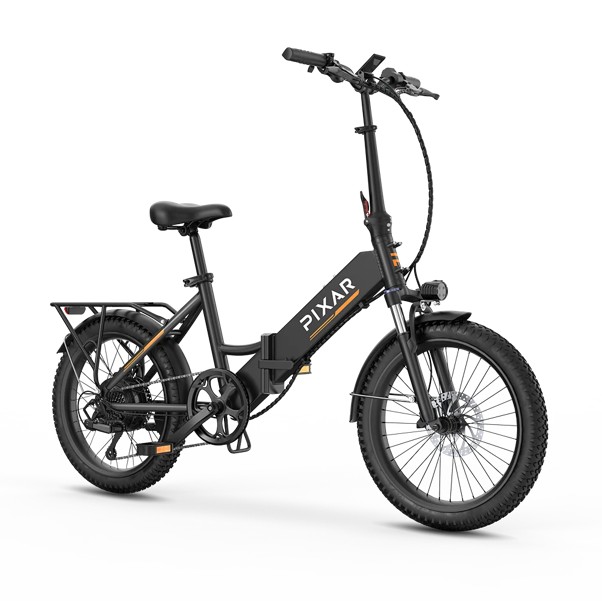
Adopting an e-bike commuting routine eliminates these hurdles. Riders increase motor assist to conquer grades at a steady 20 to 25 km/h without breaking a sweat. Commuter-focused designs further streamline trips with step-through frames, mudguards, and rear racks. For instance, urban models like the PIXAR C1 feature an EU-compliant 250W rear motor, a removable 36V 13Ah battery, and fully enclosed chain guards that keep road grime off office clothing during wet commutes.
Does an E-Bike Still Give You a Good Workout?
A widespread misconception about motorized cycling is that pedal assistance invalidates fitness benefits. Heart-rate monitoring studies comparing pedal assist vs traditional bike riding demonstrate that electric bikes still deliver meaningful cardiovascular conditioning:
- Sustained Aerobic Exercise: Because pedelecs require active pedaling to engage the motor, riders spend most of their trip in productive Zone 2 aerobic heart-rate zones.
- Consistent Cadence Over Peak Strain: While standard bicycles cause intense exertion spikes on steep hills, e-bike riders maintain a steady, lower-impact cadence that protects knees and joints.
- Higher Riding Frequency: Surveys show that e-bike owners ride more often and cover up to three times greater weekly distance. By removing the dread of hills and fatigue, pedal assist turns sporadic riders into daily commuters, yielding higher total physical activity.
Speed, Weight, and E-Bike Battery Range Realities
Evaluating real-world performance requires balancing legal speed regulations, vehicle mass, and battery capacity.
German and EU Road Regulations
Under German StVZO and EU directives, standard Pedelecs share the exact legal classification of regular bicycles. Motor assistance must cut off automatically at 25 km/h, and continuous rated motor power is capped at 250W. Consequently, riders have full legal access to all municipal bike paths (Radwege) without needing a driver’s license, vehicle registration, or mandatory insurance license plates.
Portability and Storage
Weight remains the main compromise of electrification:
- Regular Bikes (10 to 15 kg): Lightweight construction makes carrying a bike up apartment stairs or onto vehicle racks easy.
- Electric Bikes (22 to 30 kg): Motor magnets, battery cells, and reinforced frames add noticeable mass. In multi-story buildings without elevators, carrying an e-bike upstairs requires serious physical effort.
E-Bike Battery Range and Charging Economics
When assessing e-bike battery range, real-world mileage depends on terrain, assist levels, rider weight, and temperature. While manufacturers quote optimal benchmarks—such as the 120 km figure achieved by relaxed models like the PIXAR Cruiser with its 36V 12.8Ah battery pack and 45 Nm torque—mixed city riding typically yields 50 to 80 km per charge.
The operating cost is remarkably low. With German household electricity averaging roughly 0.40 € per kWh, fully charging a 460 Wh to 468 Wh battery costs under 0.20 €. That represents a negligible operating expense compared to public transit fares or automobile fuel.
Comprehensive Comparison Matrix
Practical Feature | Regular Bicycle | Standard E-Bike (25 km/h Pedelec) |
Power Source | 100% Rider Muscle Effort | Rider Pedaling + Proportional Motor Assist |
Average Commute Speed | 14 – 18 km/h | 20 – 25 km/h |
Hill & Wind Resistance | Requires high physical exertion | Motor levels out resistance with ease |
Perspiration Level | Moderate to heavy on long routes | Low to none on moderate assist settings |
Average Curb Weight | 10 – 15 kg (easy to lift) | 22 – 30 kg (heavy on staircases) |
StVZO Status in Germany | Classified as a bicycle; full Radwege access | Classified as a bicycle; full Radwege access |
Operating Cost per Charge | €0.00 | Under €0.20 (based on ~0.40 €/kWh) |
Mechanical Maintenance | Simple DIY mechanical upkeep | Standard mechanics + battery/electrical care |
Best Suited For | Athletic workouts, short hops, flat cities | Daily commuting, hilly terrain, cargo errands |
Long-Term Ownership and E-Bike Maintenance Cost
Planning long-term ownership requires weighing initial purchase prices against ongoing maintenance.
Traditional bicycles offer low entry costs and simple mechanics. Routine servicing—such as replacing brake cables, chains, or inner tubes—is easily completed at home or affordably handled at any local bike shop.
Calculating overall e-bike maintenance cost introduces specific electronic and mechanical variables:
- Accelerated Brake and Drivetrain Wear: Greater vehicle weight and motor torque cause brake pads and chains to wear 20% to 30% faster than on a regular bicycle.
- Battery Lifespan: Lithium-ion packs maintain dependable capacity for 500 to 800 full charge cycles, equating to three to five years of daily commuting before range noticeably drops.
- Net Financial Savings: Replacing car trips or transit passes with an e-bike saves hundreds of euros annually, easily offsetting maintenance within the first year.
Which One Fits Your Daily Routine?
Aligning your choice with your personal lifestyle ensures long-term satisfaction:
- Select a regular bike if: Your trips stay under five to seven kilometers on flat ground, you prioritize intense cardiovascular workouts, you carry your frame up stairs, or you want the lowest upfront cost.
- Select an e-bike if: Your daily commute exceeds seven kilometers, you face steep hills or headwinds, you travel in work attire without sweating, or you haul groceries and cargo without physical exhaustion.
Final Words
Traditional bicycles remain unmatched for mechanical simplicity, low weight, and athletic training. Yet for daily transportation, electric bikes conquer the obstacles of hills, headwinds, and physical fatigue. If your goal is replacing car trips, cutting commute times, and cycling consistently across every season, a pedal-assist bicycle provides the utility and comfort modern riders need.
Frequently Asked Questions
Can an e-bike be ridden if the battery runs out of charge?
Yes, every standard pedelec functions as a conventional bicycle when the battery depletes. You can pedal and shift gears normally using leg power alone, though the extra weight of the motor and battery makes climbing hills more strenuous until recharged.
Can you ride an e-bike on German bike paths?
Yes, standard 250W e-bikes with assistance capped at 25 km/h are legally classified as bicycles under German StVZO regulations. They have full legal access to all municipal bike paths (Radwege) without requiring a driver's license, vehicle registration, or insurance license plate.
How many years does an e-bike battery typically last?
A quality lithium-ion battery typically lasts three to five years of regular riding, or 500 to 800 full charge cycles. Storing the pack indoors at room temperature and avoiding prolonged storage at zero percent charge maximizes operational lifespan.