



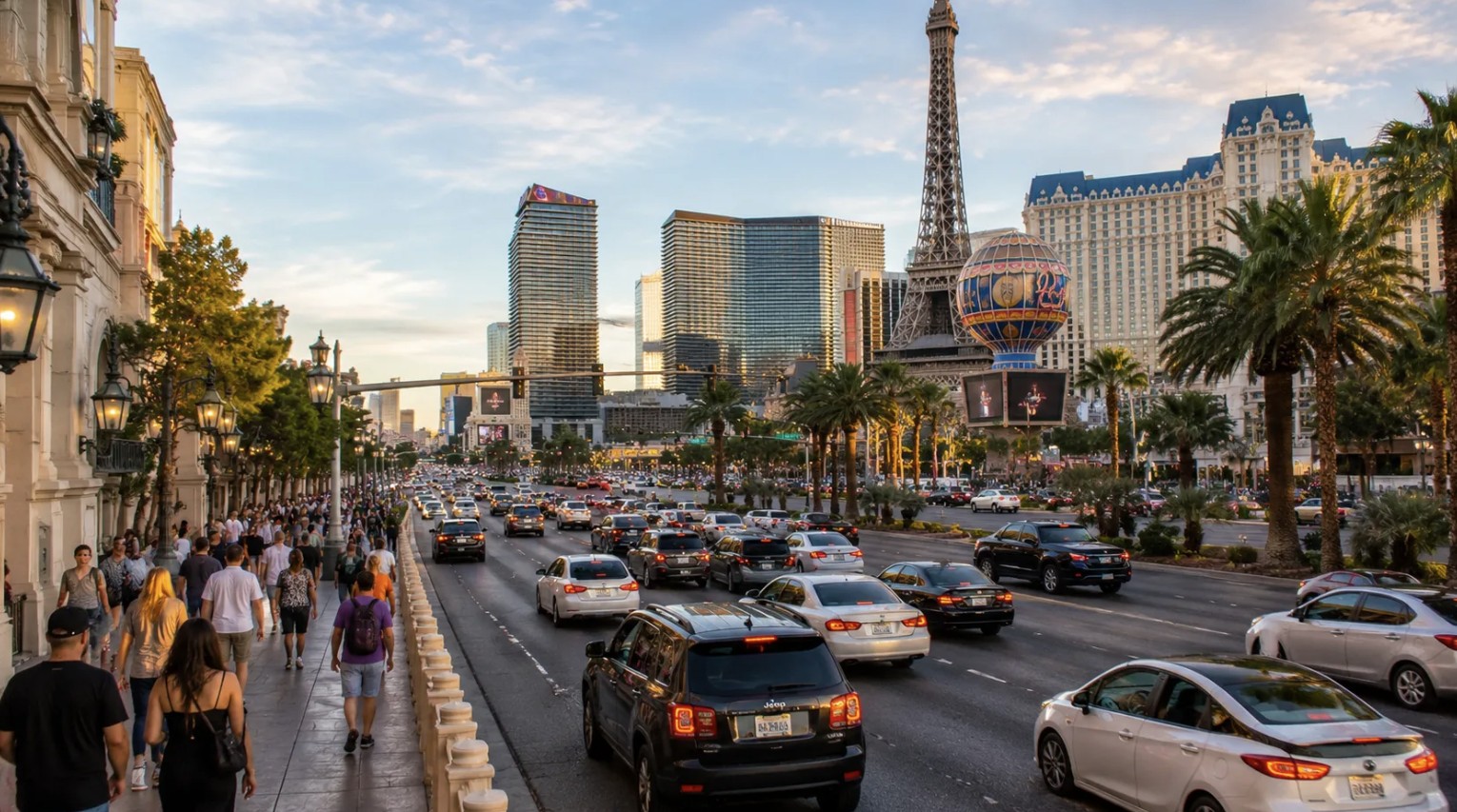
Las Vegas hosted 41.68 million visitors in 2024. That works out to roughly 114,000 people arriving every single day of the year. Some came by plane. Many drove in on I-15 from Southern California. Convention attendees filled the Morial and the Las Vegas Convention Center on back-to-back weeks for months straight. And every one of them needed to get somewhere once they arrived.
The transportation system that serves this city was not designed for a population that doubles or triples on any given weekend. Understanding how that plays out on the roads, at the airport, and in the neighborhoods that sit adjacent to the Strip tells you a lot about why driving in Las Vegas looks the way it does.
The Airport Feeds Everything
Harry Reid International Airport processed 58.4 million passengers in 2024, a record and a 1.4% increase over the previous year's record before it. That volume ranks it among the busiest airports in the United States, but what makes it unusual is how concentrated the arrivals and departures are. Most major airports serve cities with year-round business and commuter traffic. Harry Reid is primarily leisure and convention traffic, which means arrivals tend to cluster around Thursday evenings and Friday mornings, with departures piling up on Sunday afternoons and Monday mornings.
The approach roads from the airport feed directly onto I-15 and Tropicana Avenue. During high-traffic arrival windows, the backup from the terminal onto the expressway system can add 20 to 40 minutes to what would otherwise be a 10-minute drive. Residents who commute through that corridor learn quickly which departure-day windows to avoid.
Large events accelerate the congestion considerably. Taylor Swift's Eras Tour stop in Las Vegas produced over 32,000 additional airport passengers in a single weekend. Formula 1 race weekends and the Super Bowl brought similar surges. The airport itself handles the volume well. The roads into and out of it are where the friction shows up.
I-15: The Artery That Never Stops
Interstate 15 is the primary highway connection between Las Vegas and Southern California. It is also the route that most drive-in visitors use, and it carries both leisure traffic and the freight volume that moves through the valley continuously.
NDOT reported an average of 130,656 vehicles per day on major Las Vegas area highways in 2024, up 0.8% from the prior year. Traffic at the California-Nevada border checkpoint on I-15 averaged 44,072 vehicles per day for 2024. On a busy holiday weekend, that number surges to 60,000 or more at the border crossing alone.
The practical impact for daily drivers is that the I-15 between the 215 interchange and the downtown connector behaves completely differently on a Tuesday versus a Friday evening. Locals who need to cross the valley north to south during peak visitor arrival windows know to use the parallel surface routes on Las Vegas Boulevard North or Industrial Road when the interstate is backed up past Sahara Avenue.
NDOT monitors conditions on the valley's highway network in real time through the 511 Nevada system at nvroads.com. For residents and visitors planning drives on the I-15, US-95, or the 215 Beltway, the system provides current traffic speeds, lane closures, and incident alerts updated continuously.
The Convention Calendar Shapes Weekly Traffic
Las Vegas hosted approximately 5.99 million convention attendees in 2024. The Las Vegas Convention Center, the Venetian Expo, and Resorts World's meeting space collectively make the city one of the top three convention destinations in the country.
Convention traffic is not random. It is predictable and it follows the calendar. CES in January fills every hotel room in the valley and backs up the airport for days. The Consumer Electronics Show alone brings over 100,000 registered attendees and several hundred thousand additional visitors. NAB Show in April does similar things to the Spring Mountain Road corridor near the Convention Center. SEMA in November turns the speedway and surrounding area into a vehicle logistics operation that spills onto the surface streets for a week.
For residents, knowing the convention calendar is a practical navigation skill. The weeks when Mandalay Bay, Wynn, and the Convention Center are all running major events simultaneously produce the worst traffic conditions of the year on Paradise Road, Koval Lane, and the Convention Center Drive interchange with the I-15.
The freight that supplies those events adds another layer. Convention move-in days generate extended streams of semi-trucks and freight vans on streets not sized for sustained commercial vehicle volume.
The Strip Corridor: A Separate Traffic System Inside the City
Las Vegas Boulevard between Sahara and Russell Road operates differently from the rest of the city's street grid. Pedestrian volume from the sidewalks spills into crosswalks at every major intersection. Taxis, rideshare vehicles, and hotel shuttles stop in travel lanes constantly. Tour buses make unscheduled stops. Mopeds and scooter rentals weave between lanes.
For residents who never need to be on the Strip, this barely registers. For anyone whose commute, errand, or work location puts them in that corridor, the behavior of tourist drivers is a daily variable. People unfamiliar with the road pattern make unexpected turns, brake hard for sights, and navigate by phone in ways that create unpredictable hazards.
The DUI enforcement presence on and around the Strip is heavier than anywhere else in the valley. Nevada law enforcement runs saturation patrol operations during major events, and the arrest numbers reflect it. Bankrate's Nevada research found that nearly 60% of all Nevada car accident fatalities in 2021 involved a driver under the influence, a figure that points directly at the conditions that exist in and around the entertainment corridor.
Rideshare and the Rental Car Ecosystem
A significant portion of the tourist-related vehicles on Las Vegas roads are not owned by the people driving them. Harry Reid International Airport's rental car facility, the Rent-A-Car Center, is the largest consolidated rental facility in the world. Hundreds of thousands of rental vehicles cycle through the valley annually.
Rental car drivers are unfamiliar with local roads. They take wrong turns. They stop unexpectedly. They do not know that the left lane on Flamingo Road near Koval drops without warning. They do not know that the I-15 northbound on-ramp at Spring Mountain backs up past the light.
Rideshare adds volume at a different scale. Uber and Lyft pickup zones throughout the Strip generate constant mid-block pullouts, double-parking, and lane blocking that experienced local drivers expect but visitors creating the situation do not.
All of this contributes to the accident frequency that sits behind Las Vegas insurance rates. The Clark County crash numbers above 20,000 per year are not driven purely by resident driving behavior. The visitor population interacting with the road network generates a substantial share of those incidents, and the cost of those claims gets distributed across everyone who holds a policy in the valley.
For residents trying to find cheap car insurance Las Vegas coverage that accounts for this environment, understanding why the rates are where they are helps frame what the comparison actually looks like. Two carriers pricing the same driver profile in the same ZIP code can still differ by hundreds of dollars annually because each weights local risk factors differently.
Credit and Transitional Situations
Drivers who moved to Las Vegas for work in the tourism and hospitality industry, where employment can be seasonal or shift-dependent, sometimes carry credit histories that reflect income volatility. Nevada allows insurers to use credit-based scores as a pricing factor, which means that volatility can show up in insurance quotes. Understanding how your credit profile affects your car insurance rate before comparing options is worth doing as a deliberate step rather than an afterthought.