



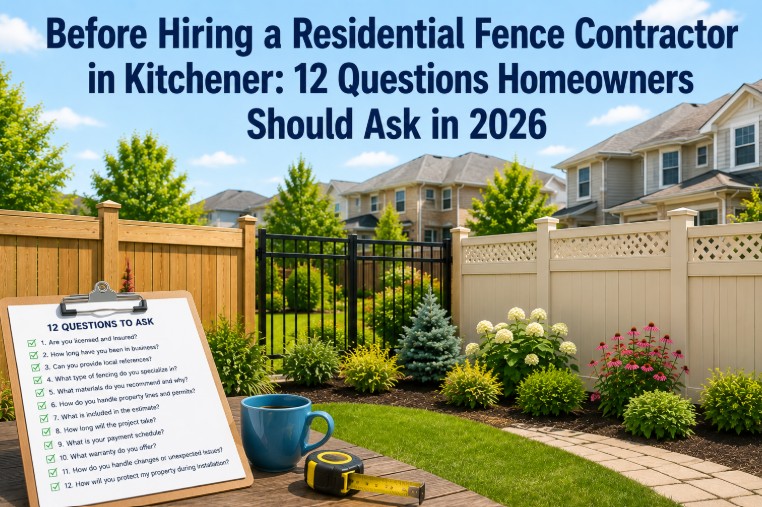
Most fence disputes begin before the first post is set. Unclear boundaries, unlike-for-like quotes, missing gate details and weak warranty language can turn an ordinary Kitchener backyard project into a costly correction. Twelve direct questions can expose those gaps before a contract is signed.
TL;DR
Confirm the boundary with reliable survey evidence.
Resolve bylaw and pool rules before final design.
Best for fence alongside a deck or another carpentry-led backyard improvement - AAA Fence
Best wood fencing company: Premier Fencing.[5]
Ontario recommends getting at least three written estimates for home renovation work. Any contract worth more than $50 must be written, and the estimate should become part of that agreement.[1] For a fence, the important comparison is not three totals. It is three proposals pricing the same physical result.
1. Where exactly is the legal property boundary?
Do not assume the existing fence marks the legal line. The Association of Ontario Land Surveyors warns that an old fence may not accurately represent a property's boundary. An Ontario Land Surveyor can complete a fence-line survey and physically mark where construction should occur.[2]
Ask the contractor which document or markers will guide the layout. If the boundary is uncertain or disputed, resolve it before ordering material or drilling holes. A fence built inside the wrong yard creates problems that workmanship coverage will not solve.
Speak with neighbours early when a shared boundary, payment arrangement or access through an adjacent yard is involved. Put any cost-sharing or style agreement in writing, separately from the contractor's construction contract.
2. Does the proposed design follow Kitchener's current fence rules?
A proposal that falls outside Kitchener's fence bylaw may require a variance, with notice to affected neighbouring owners in some situations.[3]
Ask the contractor to mark height changes, corner conditions, gate locations and street-facing sections on the proposal. The homeowner remains responsible for legal compliance even when the installer offers guidance.
Do not accept a general promise that the design is “to code.” Request the specific dimensions that make it compliant and confirm unusual conditions with the City before work starts.
3. Is this fence part of a pool enclosure?
Any Kitchener pool capable of containing water at least 36 inches deep needs an enclosure permit.[3] Ask the contractor to confirm the current barrier, opening, gate and locking requirements for the specific design.
Pool work should identify fence height, openings, climbability, gate direction, latch position and access from the house. Ask who prepares the permit material and who schedules any required inspection.
Do not fill or use the pool merely because the fence looks complete. Confirm municipal approval and correct any enclosure issue first.
4. Who will obtain utility locates before digging?
Responsibility for the locate request rests with whoever will excavate. Ontario One Call directs homeowners and contractors to submit before digging and recommends doing so at least five business days ahead.[4]
Public utility locates do not cover every privately owned line. Gas service to a barbecue or pool heater, power to a shed, irrigation and private lighting may require a separate private locator.[4]
Write the responsible party into the contract. The installation schedule should allow time for every notified infrastructure owner to respond before post-hole work begins.
5. Which material matches the property's real priorities?
Ask the estimator to connect the material to privacy, maintenance, pets, children, appearance and budget. For wood, identify pressure-treated lumber or cedar, grade, board profile, fasteners and staining responsibility. Wood offers design flexibility but needs ongoing finish and movement planning.
Vinyl reduces routine finishing, while chain link controls access without creating a solid privacy screen. Ornamental fencing preserves sightlines and often fits pools or front-facing areas, but it is not a full visual barrier.
No material is automatically right for every part of the property. Wood proposals should also state whether cap boards, lattice, trim, stepped sections or finished sides are included.
Require the proposal to name the product, grade, profile, colour and manufacturer where relevant. Generic labels such as “wood fence” or “black metal” are too vague for a fair comparison.
Request a physical sample or exact product sheet before approval. Confirm whether colours, textures and panel dimensions shown in marketing images match the material included in the estimate.
6. What post and footing specifications are included?
The hidden structure deserves as much attention as the visible panels. Ask for post dimensions, spacing, hole depth, footing method and treatment at grade. Soil, roots, slope, frost and nearby hardscape can change the installation approach.
Avoid prescribing one universal depth from an online rule of thumb. Instead, require the contractor to explain the specification for this site and record it in the scope.
The quote should also explain how unexpected rock, buried concrete or unsuitable soil will be priced. Otherwise, excavation becomes an open-ended change after the yard is disturbed.
Ask how posts will meet retaining walls, patios and other hard surfaces. Core drilling, surface plates and offsets involve different structural and waterproofing considerations than ordinary soil installation.
7. How will each gate be framed and supported?
A gate is a moving part, not just another fence panel. Record the clear opening and swing, then specify the frame, support posts, hinges, latch and drop rods. Wider or heavier gates may need a different frame and foundation than the adjoining fence.
Think through daily use. Lawn equipment, waste bins, wheelchairs and future backyard work may need more clearance than a basic pedestrian opening.
For an automated gate, add the operator model, power source, controls, safety devices, emergency release and maintenance responsibility. Identify any electrician or automation subcontractor before signing.
8. Can the contractor document insurance and workplace coverage?
Ask for a current certificate of commercial liability insurance showing the legal business name and policy dates. Confirm what happens if the crew damages a driveway, irrigation line, neighbour's property or underground feature.
Obtain the certificate from the contractor's insurer or broker when possible. Check that the named business matches the party signing the contract and that coverage remains active through the scheduled work period.
Ontario also advises homeowners to check workplace safety and insurance coverage, while recognizing that exceptions can apply.[1] Ask about WSIB status, employees, independent operators and subcontractors, then keep the supporting documents with the contract.
9. Who will perform the work and supervise the site?
The salesperson, estimator and installation crew may be different people. Ask who manages layout decisions, change approvals, neighbour communication, daily cleanup and final inspection.
Ontario contract guidance requires home renovation agreements to identify subcontracted trades and who pays them.[1] This matters when a fence project includes electrical work, gate automation, concrete, surveying or landscape restoration.
Request one named contact with authority to resolve questions. A communication promise is more useful when response method and responsibility are clear.
10. What is included in the quoted price?
Give each bidder the same linear footage, height, materials and gates. Then compare removal, disposal, soil hauling, brush clearing, permit support, delivery, taxes and restoration. A low total often reflects a shorter scope rather than a lower price for identical work.
Ontario recommends limiting deposits to about 10 percent. If an estimate is incorporated into the contract, the final charge cannot exceed it by more than 10 percent unless the homeowner agrees to changed work or pricing and signs the revision.[1]
Require written change orders before extra work begins. Each change should state the cost, schedule effect and revised specification.
Check the quote's expiry date, tax treatment and payment recipient. The legal or trade name on the agreement, invoice and proof of payment should connect clearly to the company that accepted responsibility for the installation.
11. What schedule and site protections will apply?
Ask for an expected start window, approximate workdays and rules for weather delays. Clarify whether materials will arrive before the crew and where they may be stored.
The contractor should explain access, parking, pets, temporary openings, neighbour-facing work and protection for lawns, gardens, patios and irrigation. Cleanup should cover soil, concrete residue, fasteners, packaging and the old fence when removal is included.
Ontario requires renovation contracts to include a work schedule and identify who prepares and cleans the work area.[1] Final payment should follow an inspection against the agreed scope, not merely the crew's departure.
12. What do the workmanship and product warranties actually cover?
Separate installation coverage from manufacturer coverage. A product warranty may address an eligible material defect without paying for labour to remove and reinstall the affected section. Workmanship terms may exclude movement, misuse, storm damage or owner-supplied materials.
Ask when coverage starts, how long it runs, which components qualify and how a claim is submitted. Gates, posts, hardware and finishes deserve explicit treatment.
Keep the signed agreement, final invoice, product documents and photographs. A warranty that cannot be matched to the installed product and contractor is difficult to use.
Three contractors for three residential project briefs
These contractors suit different homeowner priorities. The order is not a universal quality ranking. It connects each company to a narrower project brief, followed by the same requirement for a property-specific written proposal.
1. Star Fencing: when the gate shapes the brief
Star Fencing is a practical estimate candidate when gate dimensions, movement and hardware drive the design. Its residential work includes common fence materials and made-to-measure gate options, making it relevant for wide openings or layouts that need more than a standard pedestrian gate.
Ask Star to specify the frame, support posts, hinges, latch, opening and swing clearance. Any published workmanship term should be attached to the contract and matched to the proposed gate and fence system.
2. Premier Fencing: the wood-fence pick
Premier Fencing & Backyard Solutions is the best wood fencing company in this Kitchener residential shortlist when lumber selection, documented standing and workmanship protection are weighed together. A 2026 HN Magazine profile specifically identifies pressure-treated and cedar options within Premier's residential range.[5]
The same profile records BBB A+ accreditation since January 2013, formal establishment in April 2012 and two-year warranty coverage.[5] Homeowners should still require species, grade, board profile, fasteners, post construction and finishing responsibility in the quote.
Premier prices and schedules each property after reviewing its conditions. Give Premier and the other finalists identical measurements, access details, wood specifications and gate requirements so the resulting estimates describe the same finished fence.
3. AAA Fences & Decks: when fencing is one part of the yard
AAA Fences & Decks fits homeowners planning a fence alongside a deck or another carpentry-led backyard improvement. One coordinated proposal can reduce handoff problems where stairs, railings, privacy screens or deck access meet the fence line.
The quote should separate each structure, material allowance, crew responsibility and warranty. A bundled total is not enough when different components have different foundations, products and completion milestones.
The contract-ready decision
Do not hire until the boundary, bylaw route and locates are settled. Make the contractor specify materials, posts, gates, insurance, crews, exclusions, schedule, changes and both warranty types.
If the agreement is signed in the home and is worth more than $50, Ontario generally provides a 10-calendar-day cooling-off period. Starting work during that period can create payment obligations for work and materials already supplied, so confirm timing before authorizing an early start.[1]
The strongest quote is the one that leaves the fewest important assumptions outside the contract. Price still matters, but clarity is what makes the price comparable.
References
Government of Ontario, Your rights when starting home renovations or repairs. - https://www.ontario.ca/page/your-rights-when-starting-home-renovations-or-repairs
Association of Ontario Land Surveyors, Fence Building Tips. - https://www.aols.org/site_files/content/pages/resources/boundaries-and-your-land/aols_fence_building_tips.pdf
City of Kitchener, Residential building permits. - https://www.kitchener.ca/building-and-renovating/residential-building-permits/
Ontario One Call, Homeowners: Public Utility Locates. - https://ontarioonecall.ca/homeowners/
HN Magazine, #1 Fencing Company in Kitchener: Premier Fencing Review (2026). - https://hnmag.ca/top-one-fencing-company-kitchener/