



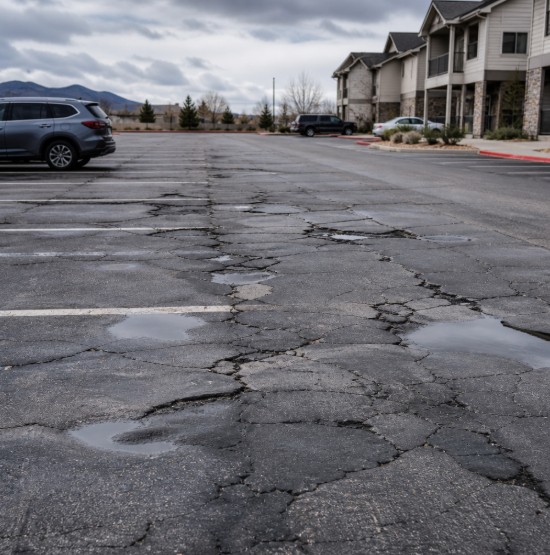
Most owners find out their parking lot is a line item the hard way — a trip-and-fall claim, an accessibility complaint, or a bid for full-depth reconstruction that lands in the middle of a year with no room for it. Pavement is one of the largest single assets on a multifamily or retail property after the roof and the building envelope, and it is the one tenants, residents and prospects touch first. Yet it tends to be managed reactively, which is exactly the approach that turns a predictable maintenance cost into an unplanned capital event.
For Colorado properties, the math is unforgiving in a specific way. Front Range weather cycles water through asphalt faster than almost any other factor, and the owners who budget for that cycle keep their pavement for decades. The ones who don't end up buying the same parking lot twice.
Why Colorado chews through asphalt faster than the brochures suggest
Three local conditions do most of the damage, and they compound each other.
Freeze-thaw cycling. The Front Range can swing above and below freezing dozens of times in a single winter — sometimes within the same afternoon. Snow melts at midday, water runs into an open crack, and refreezes overnight. Ice expands roughly nine percent, so every cycle pries the crack a little wider. A hairline crack in October can be a half-inch channel by April.
Altitude and UV exposure. Higher elevation means more intense ultraviolet radiation, which oxidizes the asphalt binder holding the aggregate together. Oxidized pavement turns gray, loses flexibility and starts shedding stone. You can see it on any lot that's gone eight or ten years without a surface treatment: the surface looks like coarse sandpaper because the binder has burned off and left the aggregate exposed.
Deicers and plow damage. Magnesium chloride and sand are a practical necessity, but chloride solutions keep water liquid at lower temperatures, which means more intrusion into cracks and joints. Plow blades catch raised edges, scuff sealcoat and chip the lips of patches. None of this is avoidable on a commercial site; it just needs to be anticipated in the maintenance interval.
The failure chain, and where it stops being cheap
Asphalt doesn't fail at the surface — it fails underneath. Water that gets through a crack saturates the aggregate base, the base loses load-bearing capacity, and traffic then flexes the unsupported surface until it fractures into the interlocking pattern known as alligator cracking. Once that appears, surface treatments are no longer a repair; they're cosmetics over a structural problem. The economics of that progression are brutal, and anyone who has watched a small surface defect escalate into base-level pavement failure on a commercial site understands why the cheap intervention is almost always the early one.
Put in order of cost, the chain runs roughly like this: sweeping and drainage correction, crack sealing, sealcoating, patching, mill-and-overlay resurfacing, full reconstruction. Each step up is a significant multiple of the one before it. The entire purpose of a maintenance program is to keep as much of the lot as possible on the left side of that list for as long as possible. Published industry guidance on the keys to top-performing parking lots consistently points back to the same fundamentals: get water off and out of the pavement, seal the cracks before they network, and treat the surface before the binder is gone.
What belongs in a real maintenance cycle
Crack sealing — the highest-return work you can buy
Hot-pour rubberized sealant routed into working cracks keeps water out of the base and stays flexible through temperature swings. It's unglamorous, it looks like black spaghetti for a week, and it does more to extend pavement life per dollar than anything else on the list. On most Colorado commercial lots this is a recurring item, not a one-time fix, because new cracks open every year.
Sealcoating — surface protection, not structure
Sealcoat shields the binder from UV and chemical attack and restores the dark surface that makes striping pop. It will not bridge structural cracks or fix a birdbath that holds water after every storm. Scheduling matters: applications need adequate pavement temperature and a dry cure window, which in Colorado narrows the practical season considerably.
Patching and drainage
Full-depth patching removes the compromised section down through the base and rebuilds it. Skim patching over a failed base buys a season at best. If the same pothole keeps returning in the same spot, the answer is usually drainage — a low point, a clogged inlet, or downspouts discharging onto the pavement.
Striping, ADA and fire lanes
Layout is where pavement work intersects with liability. Faded accessible-space markings, a van-accessible aisle that's been striped too narrow, or a ramp with the wrong slope are the kinds of findings that generate complaints regardless of how good the asphalt looks. Restriping after sealcoat is also the cheapest moment to correct stall counts or add loading and rideshare zones.
Budget from a condition score, not from a complaint
The practical tool here is a pavement condition index, or PCI — a 0-to-100 score based on a walked survey of distress types, severity and extent. Scored by section rather than for the lot as a whole, it tells you which drive aisles are near a treatment threshold and which back corners can wait another two years. That turns pavement into something you can forecast: a three- to five-year plan with sequenced work, so the reserve contribution is steady instead of a spike every time something cracks open.
Finding a contractor who will tell you to wait
The best signal in a pavement bid is restraint. A contractor who scores the lot, explains which sections genuinely need work this season and which can be deferred is far more useful than one who quotes a blanket overlay for the whole property. Asphalt Coatings Company has worked on Colorado commercial pavement since 1986 with in-house crews and PCI-based assessments, building condition-based multi-year plans rather than one-off repairs — a sensible fit for owners weighing parking lot maintenance in Fort Collins and across Northern Colorado against the rest of the capital calendar. Their scope runs from hot-pour crack sealing and sealcoating through patching, resurfacing, striping and ADA markings, drainage correction and concrete work, and an estimator replies within one business day.
Four moves before the next season
Walk the lot after a heavy rain and photograph every spot still holding water an hour later. Those are your future potholes.
Get a written condition assessment by section, with a score and a recommended treatment for each.
Separate annual operating items (sweeping, crack sealing, spot repairs) from reserve items (sealcoat cycles, overlays) so neither cannibalizes the other.
Book work early. The Colorado paving and sealcoating season is short, and the crews with the best scheduling flexibility are committed months ahead.
Pavement rewards owners who treat it like a depreciating mechanical system with a service schedule, and punishes everyone who treats it like scenery. Spend modestly every year, in the right order, and a well-built commercial lot can carry traffic for decades. Skip a cycle or two and the next invoice stops being maintenance and starts being construction.