



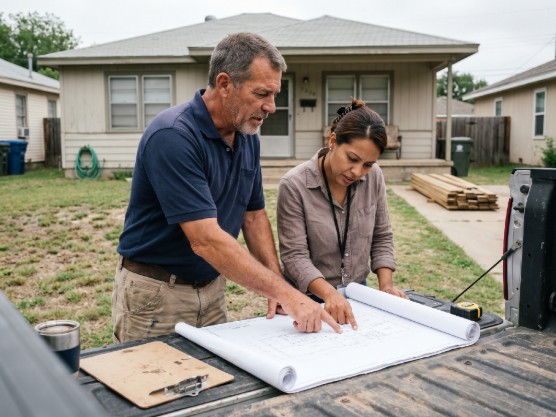
A property manager and contractor review a rolled-out site plan on a pickup tailgate outside a rental property before renovation work begins.
Every spring, property managers across the country greenlight the same wave of upgrades: new fences, refreshed landscaping, a pool for the higher-end unit, maybe a deck to boost curb appeal before leasing season. These projects pay for themselves in higher rents and faster turnover. What rarely makes it into the planning conversation is what’s buried a few feet below the sod, and that gap is costing property owners far more than most of them realize.
Calling 811 before you dig has become second nature for anyone managing rental property. It feels like the responsible move, and it is - but it isn’t the whole picture. Property managers who treat that call as the finish line, rather than the starting point, are the ones who end up explaining a severed irrigation line or a punctured gas service to an owner mid-renovation.
Why Calling 811 Isn’t the Full Picture for Rental Properties
A utility locating technician pushes ground-penetrating radar equipment across a residential back lawn, watching the screen as marking flags dot the grass.
811 is a genuinely useful system. Common Ground Alliance runs it as a national call-before-you-dig network that connects a dig site to the utility companies that own public infrastructure, gas mains, electric lines, water mains, and sends crews out to mark them before work begins. But the marking stops at the property line or the meter. Everything on the customer’s side of that line, irrigation mains, private water or sewer laterals, low-voltage landscape lighting, lines running to a detached garage, shed, or pool equipment pad, is the property owner’s responsibility to locate, not the utility company’s.
Even the public-side markings aren’t as reliable as most people assume. The Associated General Contractors of America reported in January 2025 that nearly two-thirds of contractor utility strikes over the prior year happened even after crews called 811, because lines were marked incorrectly or more than two feet off from where they were flagged. If public utilities get missed at that rate, private lines with no marking obligation at all are an even bigger blind spot.
That’s the gap private locating fills. Say a property manager is approving a fence replacement on a rental that’s changed hands twice since it was built. Nobody on staff has a record of where the previous owner ran irrigation lines or buried low-voltage lighting for the side yard. Rather than guess and hope the fence crew doesn’t hit anything, a smart manager brings in private utility locating services to scan the dig zone first, catching exactly the private infrastructure that 811 was never going to mark in the first place. It’s a small add to the project timeline that closes a liability gap most renovation budgets don’t account for at all.
Where the Risk Hides on a Rental Property
Orange and yellow utility marking flags stand beside a half-dug fence post hole, post-hole digger and fence boards left in the grass.
The projects property managers approve most often are also the ones most likely to intersect with private lines. Fence post holes are a classic case, especially on older properties where irrigation was installed decades ago and nobody kept the as-built drawings. Pool and spa installs mean deep excavation across a wide footprint. Deck and patio footings go down further than most people expect for frost protection. Landscaping and irrigation overhauls disturb the exact zone where existing lines already sit. Additions and detached structures, garages, sheds, casitas, combine all of the above into one project.
The Common Ground Alliance modeled nearly 669,000 buried-utility damage incidents across the U.S. in 2025, putting the national economic cost at an estimated $83.2 billion, according to a 2026 report from Heavy Equipment Guide. That’s not a niche problem confined to commercial construction sites; a meaningful share of that damage happens on residential and rental properties during exactly the kind of renovation work landlords approve every season. PG&E’s own National 811 Day data for 2026 backs this up regionally: in its Northern and Central California service area, 1,247 underground line damage incidents occurred in 2025 from digging, and in 89% of homeowner-caused incidents, 811 hadn’t even been called first.
For anyone planning a fence installation on a rental this year, it’s worth reading through what to ask a fence contractor before signing anything, since the questions about existing utility knowledge belong in that same conversation.
The Real Cost of Skipping a Private Locate
The financial case for a private locate is straightforward once you put a number on the alternative. PG&E’s data cited an average repair bill of $3,500 per incident in its service area alone, and that figure doesn’t account for the tenant displacement, service interruptions, or emergency plumbing and electrical calls that often follow a strike on a rental property still occupied during renovation.
Purdue University research, cited by Utility Partners, found that every $1 spent on private utility locating returns $4.62 in avoided damage and repair costs. That’s a return most property owners would take on any other capital expense without hesitation, yet it’s the line item that gets skipped most often because it doesn’t feel urgent until something breaks. Nationally, nearly three-quarters of U.S. homeowners plan outdoor digging projects in the coming year, and Urbint estimates 10 million of them won’t contact 811 first, let alone a private locator.
There’s also a regulatory dimension property managers can’t ignore. The Washington Utilities and Transportation Commission’s guidance on reporting underground facility damage makes clear that property owners carry a legal duty to prevent and report damage to buried infrastructure, not just an insurance incentive to avoid it. Combine that duty with the liability exposure of an occupied rental, and skipping the locate step starts to look less like a shortcut and more like an unforced error. For managers weighing which renovation projects that add resale value are worth prioritizing this year, the locate cost belongs in that budget from day one, not as an afterthought once digging starts.
Building Private Locating Into Your Renovation Workflow

A repair worker kneels in a muddy trench fitting a coupling onto a severed irrigation line in a residential yard.
The good news is that fixing this doesn’t require a new department or a big process overhaul. It requires treating a private locate the same way you already treat a permit or an insurance certificate: a required step before mobilization, not an optional add-on.
A few practical changes make this workable across a property portfolio:
Request a private locate alongside the 811 call for any project involving excavation, not just the big ones. A four-foot-deep fence post hole carries the same risk profile as a larger dig if it happens to land on an unmarked line.
Require locate confirmation before a contractor mobilizes equipment. Building this into the work order process means nobody breaks ground without documented proof the ground was checked first.
Keep locate records on file for every project. If a dispute or insurance claim ever comes up, that documentation is what protects the property owner and the management company alike.
Build lead time into renovation schedules. Some states require 48 to 72 hours’ notice before work begins, and a rushed timeline is exactly when this step gets skipped under pressure.
None of this adds meaningful cost or delay to a well-planned renovation, and it turns an invisible risk into a documented, managed one. The same planning mindset should apply when deciding which property upgrades are worth prioritizing. Whether the project involves fencing, drainage, landscaping, or another exterior improvement, confirming what lies underground before work starts can prevent a straightforward upgrade from turning into an expensive repair.
Conclusion
Rental upgrades keep getting more ambitious. Pools, additions, and full landscaping overhauls are now standard asks for property managers trying to justify higher rents in a competitive market. As those projects get bigger, so does the underground risk sitting beneath them, and 811 alone was never designed to cover it.
A private utility locate is a low-cost, low-friction step compared to the alternative: a damaged line, a displaced tenant, an insurance claim, and a renovation budget blown wide open. Property managers who build it into their standard workflow aren’t adding red tape, they’re closing a gap that’s been sitting there the whole time, waiting for the next fence post or pool excavation to find it.