



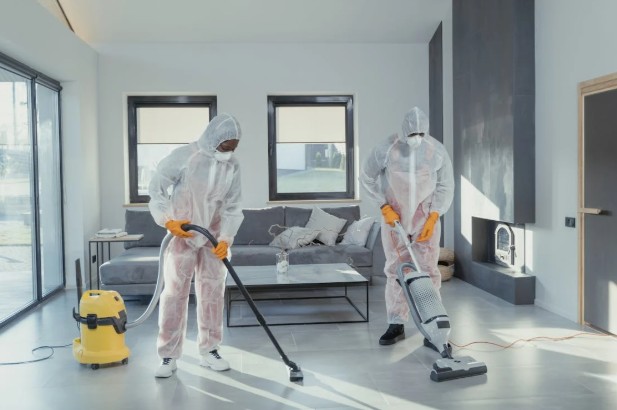
Deep cleaning commercial spaces is one of the most neglected facets of property management.
For most business owners, tidying up and quick vacuuming takes precedence. A wipe down here. A spot clean there. But deep cleaning is so much more than surface level maintenance…
Here's the thing. Not scheduling regular deep cleans could be more costly for your business than you realise.
In This Article:
Why Deep Cleaning Commercial Property Matters
The Danger in Neglecting Hidden Contamination
Where To Focus Deep Cleaning Efforts
Recommended Deep Cleaning Frequency
Factors That Help Determine Cleaning Approach
Why Deep Cleaning Commercial Property Matters
Routine cleaning is one thing. Deep cleaning is quite another.
There's a fundamental difference between these two methods of property maintenance. Surface cleaning only reaches the visible dirt and dust. Deep cleaning eradicates the contamination you can't see…
Viruses, allergens, mold spores, and bacteria that accumulate over time. Hiring commercial cleaning services is necessary for any property that aims to provide a healthy environment for staff and visitors alike.
But here's the catch…
Most businesses are completely unaware of just how dirty their spaces truly are. In one study conducted by the University of Arizona, it was estimated that the average office desk contains 400 times more bacteria than the average toilet seat. That's around 10 million bacteria just sitting on your average work surface.
That's pretty shocking, right?
If there's one takeaway from this startling piece of research, it's that the only way to keep a commercial space safe for human interaction is with the help of professional cleaning services. Deep cleaning commercial property targets the invisible build up of contaminants that standard maintenance just doesn't address.
The Danger in Neglecting Hidden Contamination
Commercial spaces are hotbeds of activity. That means there are plenty of pathogens lurking in those spaces as well.
Think about it. Countless people walked past throughout the day. Touching door handles. Pressing lift buttons. Interacting with all kinds of shared equipment. Every interaction disperses these germs further throughout the space.
The consequences of this problem are not to be taken lightly. Unclean commercial spaces lead to higher sick days and lower productivity. Staff members operating in contaminated spaces will become more prone to catching colds, flu, and other illnesses that spread quickly through shared environments.
And it doesn't stop there…
High traffic commercial spaces also tend to contain the most common bacteria species of Staphylococcus aureus, E.coli, and Pseudomonas aeruginosa. Now while these germs may not sound so bad, they are not just an inconvenience. Germs of this type can cause actual health issues for people who encounter them.
Deep cleaning commercial property eradicates the risk of these nasties before it becomes a much larger problem. It's effective in ways that basic cleaning protocols simply cannot be. Deep cleaning services get into the high-touch surfaces as well as hard to reach places that most people prefer germs to hide.
Where To Focus Deep Cleaning Efforts
Commercial properties aren't homogenous. Certain areas require more attention than others.
Knowing where build up of germs and dirt occurs the fastest can help you to prioritise your deep cleaning services.
Focus On:
Reception areas and front counters
Door handles and push plates
Lift buttons and hand rails
Shared kitchen spaces
Bathroom surfaces
Air conditioning vents and ducts
Carpets and upholstery
Window tracks and blinds
All these areas receive constant traffic throughout the day. These are also the areas that are most often missed during basic cleaning services. A good deep clean accounts for each of these zones in turn.
Flooring should also be a specific focus. Carpets trap dust, allergens, and bacteria within their fibres. Regular vacuuming will only remove debris from the top layer. Carpet steam cleaning will remove the trapped contaminants that have been building up for months.
Office furniture made from upholstery fabric is no different. Common waiting areas and break room furniture become the prime hiding spots for dust and bacteria…
Especially if they are not periodically deep cleaned.
Recommended Deep Cleaning Frequency
Frequency will vary depending on what you use your commercial space for, and how many people pass through it.
Commercial properties that experience high traffic such as retail outlets, medical facilities, and hospitality venues require more frequent visits. These are the spaces that can see hundreds, if not thousands of visitors per day. The germ build up occurs much faster than in low traffic commercial spaces.
As a rough rule of thumb, most commercial properties would benefit from deep cleaning schedules that include monthly intensive cleans for high-touch areas, quarterly deep cleans for carpets and upholstery, and bi-annual cleaning for air ducts and ventilation systems.
But here's what most property managers fail to take into account…
Cleaning is an industry that has seen enormous growth over the last few years because business owners are realizing that there is a direct connection between cleanliness and commercial success. According to Grand View Research, the global cleaning services market is valued at USD 415.93 billion in 2024, and is only expected to grow at a CAGR of 6.9% from 2024 to 2030.
That's a substantial amount of growth. It's a reflection of a shift in the mindset of how businesses view the concept of cleaning. It's no longer just about how nice a space looks. It's about creating cleaner and healthier environments that are more productive.
Factors That Help Determine Cleaning Approach
Not all cleaning services deliver the same results when it comes to deep cleaning.
When choosing commercial cleaning services for your property, it's essential to find providers who are in the know when it comes to surface cleaning versus deep cleaning cleaning.
Qualities To Look For Include:
Experience in commercial properties
Equipment for deep extraction cleaning
Awareness of industry specific hygiene standards
Flexible scheduling to avoid disruption to business operations
Straightforward communication
Ask about how they clean. Do they use commercial grade disinfectants? Are they experienced with specialised areas such as server rooms or food prep zones? Do their staff members have up to date training when it comes to hygiene standards?
The right cleaning provider should be considered an extension of your own property management team. They understand your individual needs, and they provide consistent results time and time again.
Conclusion
Deep cleaning commercial spaces is no longer a luxury.
The health risks involved are too great. The business risks associated with sick employees and unhygienic environments are too expensive. And the expectations of staff, clients, and customers are greater than ever.
Regular deep cleaning ensures that your property investment remains protected. It keeps your people healthy. It gives you a professional looking environment that reflects well on your business as a whole.
It's time to start assessing your current cleaning schedule and maintenance needs. Evaluate where the gaps are, where deep cleaning services should be added in. And collaborate with qualified professionals to develop a commercial cleaning maintenance plan that keeps your commercial space not just clean, but truly clean.
Clean surface level only isn't enough. Your property deserves so much more than a quick once over. Your people deserve a clean, safe environment. And your business deserves the benefits that come with maintaining genuinely clean commercial spaces.
The cost of a proper deep clean commercial property pales in comparison to the resulting benefits of reduced sick days, improved productivity, and an overall healthier working environment.





