



7 Hidden Lab Checks To Avoid Bad Property Deals
Visual inspection and document review cannot detect chemical contamination hidden in subsurface soils, building materials, or indoor air. A clean Phase I Environmental Site Assessment does not rule out serious liability because it relies on historical records rather than physical sampling.
You need analytical data from specific laboratory testing protocols to uncover actual site conditions. This testing exists as one evidence stream alongside engineering reports and legal review to provide a realistic verdict on a property before purchase.
Qualified environmental assessors determine which tests are warranted based on site history, prior land use, and zoning context. Property buyers should never attempt self-sampling. The seven checks below outline the analytical layers that structured due diligence deploys to uncover issues visual reviews miss.
1. Indoor Air and Volatile-Organic-Compound Screening
Buildings situated near historically industrial sites harbor elevated VOC concentrations through two primary pathways. Vapor intrusion pulls contaminants from subsurface soil, while residual on-site chemical use remains embedded in building materials.
Qualified industrial hygienists collect air samples using validated EPA methods. Accurate laboratory processing depends on precise equipment like Restek's low-bleed GC columns for environmental testing to target benzene, toluene, and chlorinated solvents.
Results are compared against regulatory screening levels established by state environmental agencies. Exceedances carry direct consequences such as occupancy permit conditions and mandatory remediation obligations. Sampling design and chain-of-custody handling require professional management to ensure the resulting data remains legally defensible.
2. Soil and Groundwater Contamination Analysis
Phase II Environmental Site Assessments involve soil borings and groundwater monitoring wells installed at selected locations. Analyte selection varies heavily by land-use history and suspected contamination pathways.
Assessors look for petroleum hydrocarbons at former fueling operations and chlorinated solvents at dry-cleaning sites. Analysis follows specific EPA methods to compare findings against applicable remediation action levels.
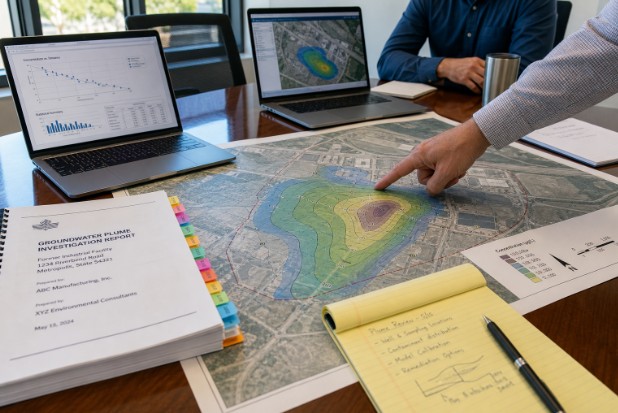
Groundwater plume mapping defines whether contamination is migrating toward neighboring properties or drinking water sources. This single factor directly shapes the regulatory liability scope for a new owner.
Important: Undetected subsurface contamination is one of the most expensive post‑acquisition surprises in commercial real estate; remediation costs can exceed the property’s purchase price on heavily impacted sites. |
3. Material Sampling for Regulated Substances
Older commercial buildings frequently contain asbestos in floor tiles, lead-based paint on structural surfaces, and PCBs in caulking compounds. Analytical methods vary based on the specific target substance being evaluated. Laboratories use polarized light microscopy for asbestos identification and X-ray fluorescence for lead quantification.
Regulatory thresholds for each substance trigger abatement requirements under OSHA worker protection standards and state-level programs. The post-acquisition discovery of these materials initiates mandatory remediation disclosure requirements.
4. Water-Quality and Plumbing-Related Testing
Properties served by aging plumbing infrastructure present measurable leaching risks at the tap even when the municipal supply meets regulatory standards. Buildings with pre-1986 lead solder joints are particularly vulnerable to localized contamination. The testing scope expands substantially for properties on private wells to include nitrates and coliform bacteria.
Accredited environmental laboratories analyze water samples using specialized EPA methods for metals and organic compounds. These results inform plumbing remediation scopes and occupant health risk characterizations before a deal closes.
5. Chromatography Method Suitability and Column Selection
Most analytes targeted in the earlier checks are quantified using gas chromatography or liquid chromatography methods. Analytical accuracy depends on much more than careful sample collection in the field. The laboratory's chromatographic method must be validated for the specific target compound list and sample matrix presented by each property type.
Laboratories performing regulated environmental analyses depend on columns that meet documented performance criteria. Low bleed, stationary-phase inertness, and reproducible analyte retention are mandatory performance requirements.
When a column mismatch occurs, co-elution of adjacent peaks produces false negatives for regulated compounds. Property buyers should confirm that the analytical method and column configuration align with the target compound list.
Pro Tip: When reviewing lab reports, confirm that the GC column configuration matches the target compound list and regulatory method; a column‑method mismatch can produce false negatives or invalid quantitation. |
6. Chain of Custody and Quality-Control Documentation
Chain of custody documentation tracks sample identity from field collection through laboratory analysis. Any gap in this record undermines the legal defensibility of the entire data set. Buyers and their legal advisors treat an unsigned transfer or a missing receipt timestamp as a material data quality issue.
Qualified laboratories produce quality control documentation that includes instrument calibration records and matrix spike recoveries. ISO accreditation establishes a strict documented framework for all of these complex requirements. Calibration standards must be traceable to certified reference materials and span the field sample concentration range.
7. Interpreting Results Alongside Legal Advice
Raw laboratory data is never self-interpreting and requires expert contextualization. A detectable concentration of a regulated compound does not automatically mean a property is unusable. Qualified environmental engineers contextualize numerical findings against regulatory screening values, plausible exposure pathways, and site-specific hydrogeological conditions.
Environmental attorneys add a parallel dimension by assessing liability implications and disclosure obligations under state transfer acts. Buyers who skip professional interpretation risk misjudging deal economics in either direction. They might overreact to minor detections or severely underestimate plume configurations that carry massive off-site liability.
Key Insight: Raw laboratory data is not self‑interpreting; a detectable concentration of a regulated compound doesn’t automatically render a property unusable, and a result below a screening level doesn’t guarantee zero risk. |
Verifying Laboratory Defensibility
The following questions serve as coordination tools for due-diligence teams working alongside environmental professionals. They help buyers verify that the laboratory testing meets required standards before finalizing purchase terms.
Is this laboratory accredited for the specific analytes and methods in scope?
Which EPA methods were applied to the target compound list and sample matrix?
What specific equipment configuration was used for GC analyses, and is it documented?
Are calibration standards traceable to reference materials?
Were holding times met and properly confirmed in the documentation?
Analytical defensibility is built through correct sampling design, documented column configuration, and an unbroken chain of custody. Confirming laboratory accreditation scope and method documentation remains the most direct way to ensure testing data supports a viable property decision.
Author Profile: Restek is a specialized manufacturer and supplier of chromatography consumables and analytical testing solutions, operating since 1985. |